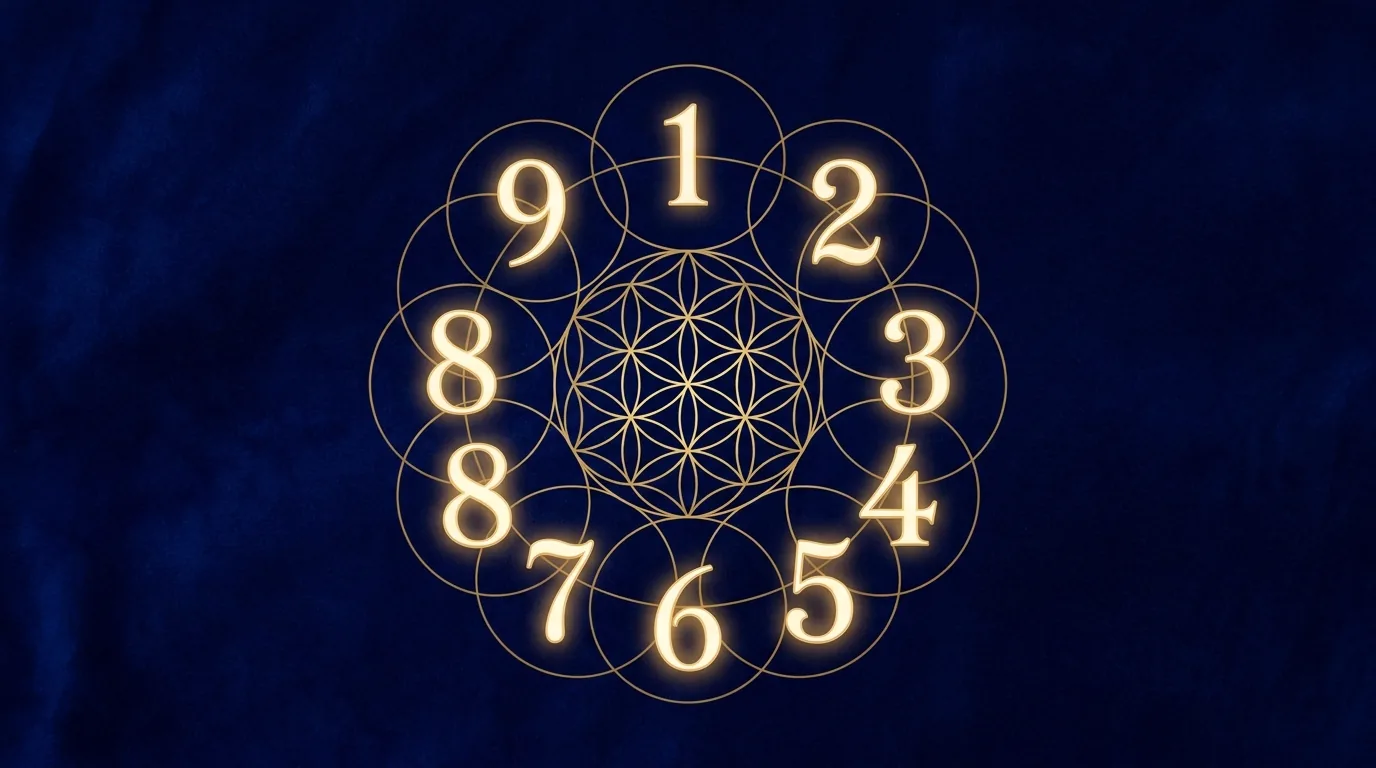
Walk through any Chinese city and the numbers tell a story. Apartments on the 8th floor sell at a premium; some buildings skip the 4th floor entirely; phone numbers full of 8s change hands for real money. This isn't idle superstition — it's a living system of numerology that assigns each number a character, largely through the sounds and symbols the culture attached to it over centuries. Once you know the logic, you start seeing it everywhere.
Let me lay out how numbers are read in the Chinese tradition, why some carry such weight, and how the same logic extends to your name, your birth date, and the door you walk through every day.
- Chinese numerology reads numbers largely by sound — 8 sounds like "prosper," 4 like "death."
- The same logic scales up: your name, birth date and house number can each be reduced to a meaningful number.
- Numbers describe tendencies and reputation, not fixed fate — use them to tilt the odds, not to rule your life.
Why 8 is lucky and 4 is avoided
The heart of Chinese numerology is homophony — words that sound alike are felt to share fortune. Eight (八, bā) sounds close to fā (發), "to prosper, to generate wealth." So eight became the number of abundance — which is why the Beijing Olympics opened at 8:08 pm on 8/8/2008. Four (四, sì) sounds like sǐ (死), "death" — so it is quietly avoided in floors, phone numbers and gifts.
The others each carry a flavour:
- 1 (一) — beginning, unity, independence; a clean, singular start.
- 2 (二) — pairs and harmony ("good things come in twos").
- 3 (三) — growth and liveliness; sounds like "birth/living."
- 5 (五) — the balancing centre, tied to the five elements; neutral, stabilising.
- 6 (六) — smooth progress; sounds like liú, "to flow" — everything goes well.
- 7 (七) — togetherness and, in some readings, a spiritual or fated quality.
- 9 (九) — longevity and completeness; sounds like jiǔ, "long-lasting," long associated with the emperor.

From single digits to your name and date
Numerology becomes personal when you reduce something meaningful — a name, a date, a number — to a single digit and read its character. Your birth date can be summed and reduced to a life number that describes your natural temperament and the themes that recur for you. Your name, converted to numbers, is read for the impression it makes and the fortune it carries — which is exactly why entrepreneurs and brands sometimes adjust a spelling or a business name to land on a stronger number.
You can test this directly. The Name & Business Numerology tool reduces a personal or brand name to its number and reads what it broadcasts — useful before naming a company, a product, or a child.
Your house number counts too
The logic doesn't stop at people. The number on your door carries a character that colours the home's feel — a "6" home tends to flow smoothly, an "8" home leans toward ambition and wealth-building, a "4" home asks for a little more conscious warmth. It's one of the easiest pieces of practical numerology to check, and it pairs naturally with feng shui. The House Number tool reads yours and explains what it emphasises.
How to use numbers without being ruled by them
Here's the grounded view. A lucky number won't make a bad plan succeed, and a "4" won't sink a good one. What numbers genuinely do is two things: they shape reputation and first impression (a business on a strong number simply lands better with people who care), and they act as a small, repeated nudge — a name or address you feel good about quietly supports your confidence. Ancient wisdom often works exactly there, at the meeting point of symbol and psychology.
So use numerology the way a strategist would: where you have a free choice — a business name, a phone number, a flat — tilt toward a number whose character matches your intention. Where you don't, don't lose sleep over it.
Start by reading a name that matters to you in the Name & Business Numerology tool, and check your door with the House Number tool.
Frequently asked
Why is 8 considered lucky in Chinese culture? Because eight (八, bā) sounds like fā (發), "to prosper." Through this homophony, 8 became the number of wealth and success — prized in phone numbers, addresses, dates and prices.
Why do some Chinese buildings skip the 4th floor? Four (四, sì) sounds like sǐ (死), "death," so it is treated as unlucky. Many buildings omit floor 4 (and 14, 24) much as some Western buildings skip 13.
How does name numerology work? A name is converted to numbers and reduced to a meaningful digit whose character is then interpreted — for temperament, reputation and fortune. The Name & Business Numerology tool does this for a personal or brand name.