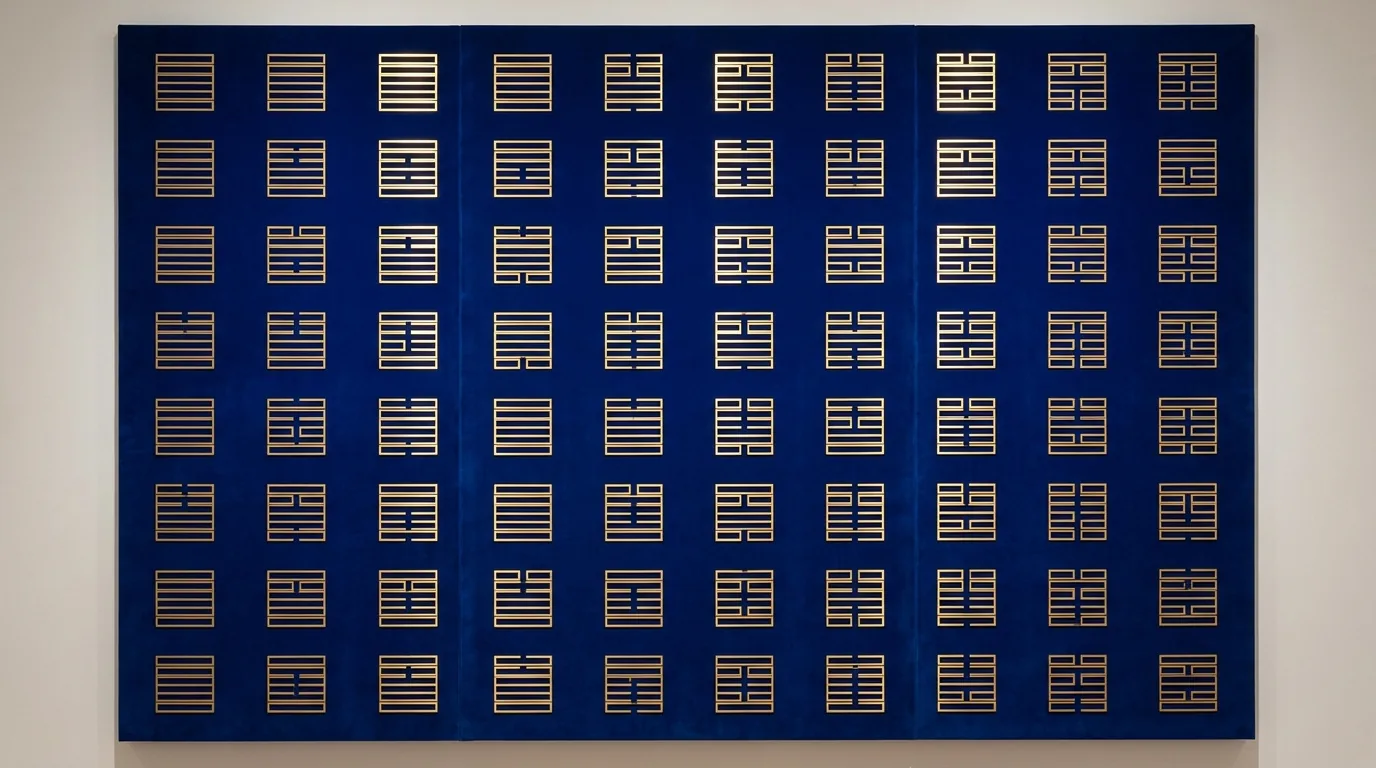
The I Ching (易經, Yìjīng) — the "Book of Changes" — is one of the oldest books still in daily use anywhere on earth. Confucius studied it. Leibniz saw binary arithmetic in it. Millions still turn to it when a decision won't come clear. Yet most people who have heard of it have no idea how it actually works. Let me take the mystery out of it, because the mechanics are simpler — and far more elegant — than the reputation suggests.
At its heart the I Ching is a library of 64 situations. Not 64 answers, but 64 patterns of change — every archetypal position life can put you in, from "Difficulty at the Beginning" to "After Completion." You bring a question; the oracle points you to the pattern you are standing inside; and the text describes how that pattern tends to unfold and what posture serves you best within it.
- The I Ching maps 64 situations, each a six-line hexagram built from broken (yin) and solid (yang) lines.
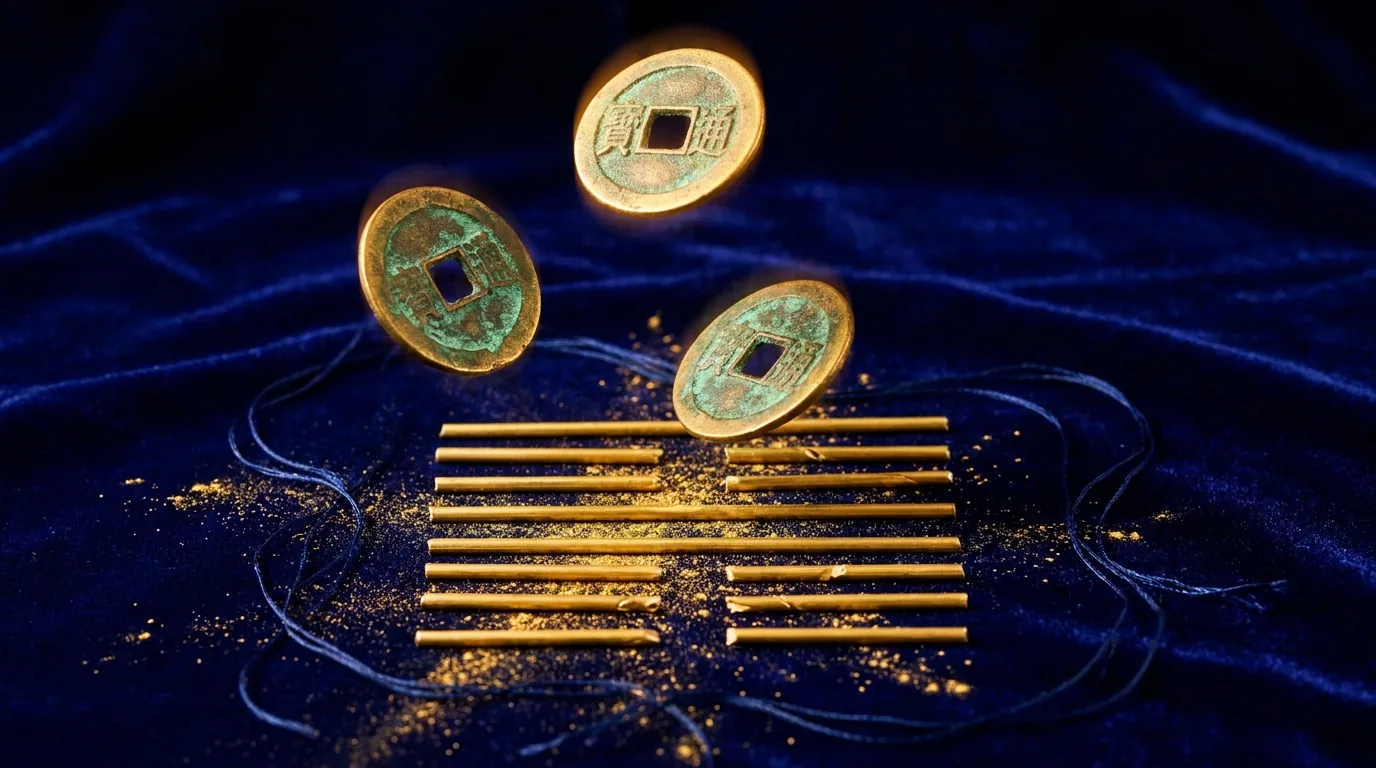
- You cast a hexagram — traditionally with coins or yarrow — while holding a clear question in mind.
- It reads best as a mirror for reflection and timing, not a fixed prediction of the future.
The building block: yin, yang, and the hexagram
Everything in the I Ching is built from two marks: a solid line (—), yang, active and firm; and a broken line (— —), yin, receptive and yielding. Stack three of these and you get one of the eight trigrams — the familiar symbols of Heaven, Earth, Water, Fire, Mountain, Lake, Thunder and Wind. Stack two trigrams and you get a hexagram: six lines, one of 64 possible combinations.
That six-line figure is the oracle's whole vocabulary. The lower trigram is often read as the inner situation, the upper as the outer; together they name where you are.

How to actually consult it
The traditional method uses three coins. You hold your question clearly in mind, toss the three coins six times, and each toss builds one line from the bottom up — heads and tails deciding whether each line is yin or yang, and whether it is changing. The older yarrow-stalk method takes longer and produces a slightly different probability, but the principle is identical: a small ritual of chance that fixes your question to one of the 64 figures.
The free I Ching Oracle does the casting for you — you focus on the question, and it returns your hexagram, its meaning, and any changing lines. If you prefer the closely related, faster Plum Blossom method, the Plum Blossom Oracle casts from time and number instead of coins.
Two rules make the answer far more useful:
- Ask well. "Should I take the job?" invites a yes/no you won't get. "What do I need to understand about taking this job?" invites the kind of answer the I Ching actually gives — a description of the terrain.
- Watch the changing lines. When a line is changing, it transforms into its opposite, generating a second hexagram. The first hexagram is your present situation; the second is where it is tending. The changing lines themselves carry the most specific advice in the whole reading.
Reading the answer without fooling yourself
Here is the honest part. The I Ching does not tell you what will happen. What it does — remarkably well — is hand you a considered, archetypal description of your situation and its likely movement, phrased vividly enough to cut through your own noise. Sometimes it simply says the thing you already knew but were avoiding.
Approached that way, it is less a fortune-teller than a thinking tool with three thousand years of polish: a structured pause that forces you to name your question precisely and then reflect on an answer you did not author. Whether you read the "energy" literally or treat it as a mirror, the value is the same — you leave the reading clearer than you arrived.
For decisions with a strong timing element — when to act, not just whether — pair your reading with your own chart. The BaZi Four Pillars shows the elemental season you are in, and the I Ching shows the shape of the specific choice inside it.
Start with one honest question
Don't begin by testing it with "what number am I thinking of." Begin with something that genuinely weighs on you, phrased as an open question, and read the whole answer — the hexagram, its image, and the changing lines — slowly. Ancient wisdom rewards a serious question with a serious answer.
Cast your first hexagram in the I Ching Oracle, and let the Book of Changes describe the change you're standing in.
Frequently asked
What is the I Ching used for? It is an oracle and a book of wisdom. People consult it for guidance on decisions, timing, and understanding a situation — casting a hexagram in response to a clear question and reading the text that corresponds to it.
How do you consult the I Ching? Hold a clear, open question in mind and cast a hexagram — traditionally by tossing three coins six times, or using the I Ching Oracle to do it for you. Read the resulting hexagram and any changing lines, which point to how the situation is tending.
Is the I Ching about predicting the future? Not in a literal sense. It describes the pattern and likely movement of your present situation, functioning more as a mirror for reflection and timing than a fixed forecast. Your choices still decide the outcome.