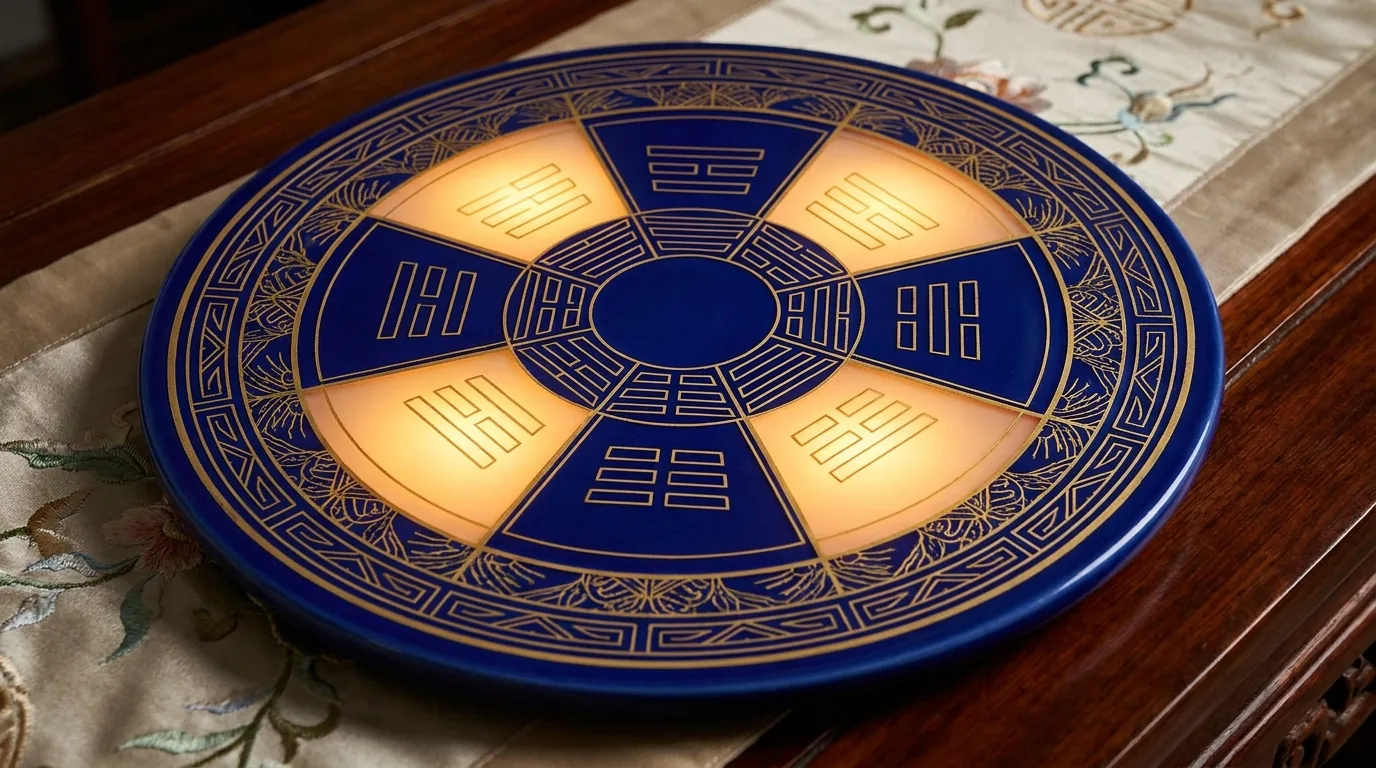
Of all the Feng Shui most people can actually use without hiring anyone, this is the one I'd start with. It costs nothing, changes nothing physically, and yet it quietly re-tunes your day: which way you face when you work, sleep and eat. It comes down to a single number — your Kua (卦), also called your Gua or Ming Gua — and the eight directions it sorts into good and bad for you personally.
You can get yours instantly in the free Lucky Directions calculator, but let me explain what it's actually telling you, because once you understand it you'll use it for life.
- Your Kua number (from birth year + gender) sorts the eight directions into four good and four bad.
- Sheng Qi is your personal wealth-and-success direction — face it at your desk.
- East group (1,3,4,9) and West group (2,6,7,8) thrive facing opposite sets of directions.
East group or West group
Your Kua number, calculated from your birth year and gender, is a single digit from 1 to 9 (there's no personal 5 — men with a 5 use 2, women use 8). That number places you in one of two families:
- East group: Kua 1, 3, 4 and 9.
- West group: Kua 2, 6, 7 and 8.
This isn't about where you live — it's about which set of directions harmonises with your personal energy. East-group people thrive facing east, south-east, south and north. West-group people thrive facing west, north-west, north-east and south-west. Face "your" directions and things feel smoother; face against them and you'll often feel a low, nagging friction you can't name.
Your four good directions
Each Kua number has four auspicious directions, and — this is the useful part — they're not interchangeable. Each does a different job:
- Shēng Qì (生氣) — Success & Wealth. Your best direction, full stop. Face it when you want momentum: at your desk, in a negotiation, when you're working toward a goal.
- Tiān Yī (天醫) — Health. The "heavenly doctor." Sleep with your head toward it when recovering, and orient your kitchen or dining here.
- Yán Nián (延年) — Relationships & Longevity. For harmony, love and stable partnerships. Face it in conversations that matter; a good direction for the marital bed.
- Fú Wèi (伏位) — Stability & Clarity. For calm, focus and personal peace. Excellent for study, meditation or steadying a scattered mind.

Your four directions to avoid
The other four range from mildly draining to seriously unhelpful:
- **Huò Hài (禍害) — mishaps and small setbacks.
- **Wǔ Guǐ (五鬼) — the "five ghosts": conflict, betrayal, things going missing.
- **Liù Shā (六煞) — the "six killings": stress, legal and relationship trouble.
- **Jué Mìng (絕命) — "total loss": the most draining direction for you, tied to health and finance.
Don't panic about these. In practice, the goal is simple: face your good directions where it's easy, and avoid pointing your bed, stove or main working seat at your worst one.
How to actually apply it
Three high-leverage moves, in order of impact:
- Your desk / working seat. Face your Shēng Qì (success) direction. This is the single most valuable application — you spend hours here, aimed one way. The Office Desk Direction tool works this out for you.
- Your bed. The classical rule is to sleep with the crown of your head pointing toward a good direction — Tiān Yī for health, Yán Nián for relationships. See Bed Direction.
- Your front door and stove. Trickier, because these are fixed. Where they can't be moved, the aim is to not have them working against you, and to remedy where they do.
The catch nobody mentions
Your Kua directions are a personal layer — but a home also has its own Feng Shui (its facing, its Flying Stars). A perfect personal direction that sits in a bad annual star sector is a compromise, and reading the two together is where a real consultant earns their fee. If you share a home, spouses often belong to different groups, which is why the bedroom is usually tuned to the couple and the studies/desks to each individual.
Start small and specific: find your Kua, turn your desk to face your success direction this week, and notice how the next fortnight feels. Feng Shui, done right, is a series of quiet adjustments — not a renovation.
Find your number and four directions in the Lucky Directions calculator.

Frequently asked
How do I calculate my Kua number? It's derived from your birth year (using the solar year, which begins ~4 February) and your gender. The free Kua calculator does it precisely and lists your four good and four bad directions.
What is my Sheng Chi direction? Shēng Qì is your personal wealth-and-success direction — the best of your four. Face it at your desk and in important moments. It differs for each Kua number.
Do husband and wife share the same lucky directions? Often not — they can be in different groups (East vs West). The usual solution is to tune shared spaces like the bedroom to the couple, and personal desks to each person's own Kua.